This blog is about the lesser known but beautiful, wonderful, huge, unique and sometimes bizarre places around the World. Started on January 1, 2009, it is an outcome of my association with Google Earth Community, which I joined in July 2006. Since then I have been regularly flying to almost all the corners of WWW (Whole Wide World) and have virtually adopted the age old motto - Perfect time to see the World is after retirement.
Google Earth Community Forum is full of information which ranges from, but not limited to; history, geography, nature, environment, architecture, military, transportation, beliefs, festivals, huge, unique, bizarre items, current happenings etc etc.
My favourite section in the Community is "Fun and Games" - in which members post riddles and puzzles on almost all subjects and generally give hints for searching and locating the relevant places and or events on Google Earth. I have made several hundred posts in this forum and must have solved about the same number, though several were beyond my grasp. Believe me it is not easy to solve these riddles - Finding the answer is 90% perspiration (research) and 10% inspiration but it is pure 100% joy and sense of exhilaration.
This forum provides a stimulus to my brain and keeps it active. I strongly recommend this for those who have time and penchant for solving puzzles, but a word of warning – it is highly addictive.
My travels around the World are not limited to Fun and Games only, however many of the places being covered in this travelogue were found as a result of my researches for making posts in Fun and Games or trying to solve the riddles given therein.
The Original Google Earth Community was frozen by Google in April 2015 and finally killed in April 2019. However the dedicated moderators of the defunct Original GEC created a new Board for the GEC enthusiasts and the new Community is known as "Google Earth Community Forums". This new community continues to function as the old GEC but is independent of google.com
Google Earth
To view the Google Earth links given in this travelogue, the "Google Earth" application should be installed in your system. If it is not, then click on following button to get it!
All other links can be directly accessed through your browser.
The town of Khun Han in Sisaket province, Thailand boasts of a unique temple built using more than one million (as per some sources about 1.5 million) empty beer bottles.
The temple officially called Wat (meaning Temple) Pa Maha Chedi Kaew is also known as "Wat Lan Kuad" - Million Bottle Temple.
The temple was born out of a simple idea of local Buddhist monks who wanted to utilise the discarded empty beer bottles littered all over the town. In 1984 they started collecting the empties and also encouraged the local population to bring in the empty bottles. Work on the temple was started once they had collected one million bottles.
The result was a remarkably colourful structure made mainly with green (Heineken) and brown (Chang Beer) bottles. Entire structure including the floors were built with bottles embedded in cement mortar. The wall murals/ decorations were made from the bottle caps, however out of respect for the Deity, the statue of Buddha was not made from the recycled bottles.
The monks didn’t stop once the main temple was completed and they continued to collect empty bottles to make other buildings in the complex with glass bottles - the shelters, the water tower, monks' quarters, visitors' rooms, crematorium, toilets etc.
To the monks it is a continuous process and they say the more bottles they get the more they will build.
Using the recycled bottles is not only eco-friendly but also provides natural lighting and ease of maintenance. The glass doesn’t fade and is easy to wash as compared to normal mortar.
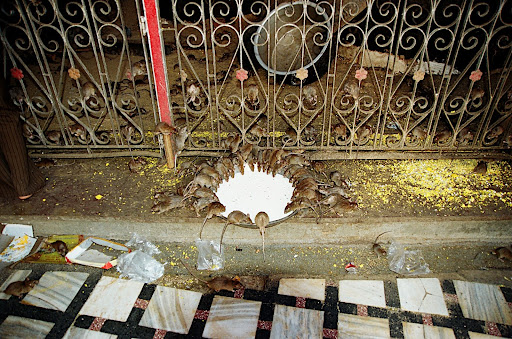
Karni Mata temple located in the small town of at Deshnoke, 30 km from Bikaner, Rajasthan, India, is one of the strangest and perhaps most bizarre temple in the World.
As per Wikipedia "According to a local legend, Karni Mata, the 14th century mystic and an incarnation of Hindu goddess Durga, implored, Yama, the god of death to restore to life, the son of a storyteller, and upon his refusal she incarnated the dead son, and all of the storytellers as a rat, under her protection".
Her devotees therefore, protect the rats, treat them as sacred and regularly feed them in the precincts of the temple. The rats, which number several thousands, are every where and are ready to nibble the food from the hands of the devotees. It is considered fortunate if a rat scampers over ones feet, and sighting a white rat amidst hordes of black/brown rats is considered especially auspicious. Some devotees even drink water or eat food which has been sampled by the rats. As per National Geographic "For an animal that is commonly associated with pestilence and disease, this may seem strange. But during the century of this temple's existence, there has never been an outbreak of plague or other ratborne illness among the humans who have visited.....". However this statement has to taken with pinch of salt as there is no recorded statistics of how many persons visiting the temple were later afflicted with rat borne diseases.
Exact history of the construction of the temple is not known; however, in its present form it was completed in the early 20th century by the late Maharaja Ganga Singh of Princely State of Bikaner. The temple is built in Mughal architecture with marble carvings on the walls/pillars and has huge silver gate.
About year and a half back I had made a posts about a building in Potsdam, Germany which is Not A Mosque but looked like a mosque. Today I present another unusual building in Egypt which is not a temple but looks like an Indian temple.
The Palace of Baron Empain (Arabic: Qasr Al Baron) aka as Palais Hindou, in Heliopolis, a suburb of Cairo, is a residential palace built by Belgian born Baron-General Edouard Louis Joseph Empain in 1911. The design and decorations of the palace took inspiration from temples in India specially the temples in Orissa/South India. The palace was designed by French architect Alexandre Marcel and decorated by Georges-Louis Claude.
Baron Empain, a Belgium entrepreneur arrived in Egypt in 1904 and fell in love with the desert. He started the Cairo Electric Railways and also developed a new luxury town ship near Cairo by buying about 25 square kilometres of cheap desert land, northwest of Cairo. The township was designed as a city of luxury and leisure. His palace built on a raised artificially created platform, was one of the first building to be built in the area. Reportedly he wanted to watch the progress of Heliopolis city from his palace.
Unfortunately after his death the palace fell into disrepair due to squabbling of his successors and subsequent owners. Many of its interior decorations were plundered by looters and walls and frescoes defaced with graffiti. It was reportedly also used by drug peddlers and by devil worshippers and ultimately it became home to bats and stray dogs.
The Egyptian government has now acquired it and plan to renovate and convert this unusual building into a Museum.
'The Temple' in the town of Independence, Missouri, is a house of worship of the Community of Christ (formerly the Reorganized Church of Jesus Christ of Latter Day Saints). It is part of the headquarter complex the Community of Christ.
The temple was designed by Gyo Obata who based the design on the spiral shape of shell of nautilus.
The groundbreaking took place April 6,1990, and the temple was dedicated on April 17, 1994. The temple's main sanctuary has seating for approximately 1,600 persons and entry to the sanctuary is through a beautifully etched glass archway leading to the gently ascending worshiper's path of textured stone which spirals around
its periphery. Its wide steps open up onto a world plaza with global map of inlaid brick. Temple's spiral shaped stainless steel spire rises to a height of 300 feet (91.4 metres) and is visible from large distances.
The temple also contains the church archives, the Temple School, administrative offices of church headquarters, theaters used for visitors and also for meetings, presentations, classes, and a museum.
The temple holds a daily prayer which is open to the public. The building has become a popular tourist attraction.
World's Oldest Wooden Building, is a five-story pagoda, part of Hōryū-ji (Meaning: Temple of the Flourishing Law) Buddhist temple complex in Ikaruga, Nara Prefecture, Japan.
The temple complex was completed in 607 AD. As per tree-ring dating (Dendro-chronological analysis) the wood used in the central pillar of the pagoda is estimated to have been felled in 594.
The pagoda has a height of 32.45 meters (122 feet) and its base is about 6.1x6.1 metres (20x20 feet) square.
The main hall of the the temple (kondō) which is located side-by-side to the Pagoda is widely regarded as the second oldest wood building extant in the world. The hall measures 8.5 meters by 15.2 meters. Extensive damage was caused to this old structure due to fire which broke out on January 26, 1949. Although it has been reconstructed it is estimated that about only fifteen to twenty percent of the original seventh century Kondo materials is left in the current building.
Due to this unfortunate fire damage and subsequent restoration the main hall is considered as the second oldest and the Pagoda is considered to be the oldest wooden structure in the World. It is also listed in the
Guinness World Records.
In 1993, the complex was included in UNESCO World Heritage Site and a National Treasure of Japan.
The Karla and Bhaja Cave complex, near Lonavala on Mumbai-Pune expressway are one of the finest examples of the ancient rock-cut caves found in India and predate the World famous Ajanta and Ellora caves.
These caves have been built, rather excavated, by hewing out the rocks from the difficult terrain of a rocky hillside. During this period it is likely that thousands of caves like Karla were excavated in surrounding Sahyadri Hills. These caves are on an major ancient trade route, running eastward from the Arabian Sea into the Deccan. As per historians Buddhism, having become identified with commerce and manufacturing through their early association with traders, tended to locate their monastic establishments in natural areas close to major trade routes so as to provide lodging houses for travelling traders.
Karla Caves complex was built over the period of 3rd to 2nd century B.C. and the oldest one is believed to date back to 160 BC. The complex is believed to be the oldest surviving Buddhist school (Theravada - Meaning "the Teaching of the Elders" or "the Ancient Teaching").
The main cave has a magnificent carved prayer hall with huge pillars and intricately carved relief's and that houses a stupa. On ef the strange feature is that these caves do not actually show the image of Buddha. The outside facade has intricate details carved to imitate finished wood.
Bhaja Caves complex is a group of 18 rock-cut caves dating back to 200 BC and is about 6 km south of Karla Caves. These caves share the same set of architectural designs and style as the Karla Caves.
There is a small Buddhist temple close to Sanchih (aka Sanjhih or Sanzhi), Taiwan, whose walls are almost completely covered with sea-shells. Popularly known as Sea-Shell Temple, its entire interior is beautifully decorated with pictures/mural created by using sea-shells and corals.
Very little info is available about this temple except that its Chinese name is Pei Khe Miao.
The beauty of the interior can be visualised by the images and the YouTube video given below.
The Big temple of Thanjavur (earlier Tanjore) in Tamil Nadu, India known as the Brahadeeswara temple is one of the greatest masterpiece of not only the Cholas but also of the Indian architecture. Dedicated to lord Shiva, it was built by Raja Raja Chola – I, from 1003-1010 AD and is entirely made of hard granite stone, a material sparsely available currently in Thanjavur area where the temple is located.
The 13 storey temple tower is about 66 metres high and is shaped like a pyramid with square base of about 25 metres x 25 metres. The design of temple is such that shadow of the tower never falls on the ground and because of the carvings, the shadows on the sloping walls are also not easily discernible to the spectators at the ground level. This gives the temple an aura of awe and mystery.
The Cupola or the bulbous structure on the top of the temple has been carved out from a single monolithic granite about 7.5 x 7.5 metres square, weighing about 81 tons. Its installation at the top is an engineering marvel. It has been estimated that a six kilometre long ramp must have been used to carry it to the top.
The temple and the its entrance gates and other structures in the complex have beautiful stone carvings on the walls and insides. The temple roofs have some beautiful murals. It is listed in UNESCO World Heritage Site.
Here are some images of the temple complex. To fully appreciate the beauty of the carvings, it is suggested that the images be viewed in their largest size, which can be selected after clicking on the link given below each image.
Screen captured images from Google Earth / Google Maps and Street Views / MSN Bing Aerial Views / Yandex Maps etc. are under the copyright of their respective owners. Similarly all other photos/images from various other sources are under the copyright of their respective owners, web portals/application etc from which these were obtained. Wherever possible due acknowledgement has been made about the source. Actual terms of copyright/reuse is available in the source link given below each image.
I solicit comments on my posts and also request information/ links to unusual places for inclusion in this travelogue. I will duly acknowledge my source of information.
If you are having any problem in opening Google Earth link then please let me know through comment box or e-mail me. I will send the desired kmz/kml file.
E-mail:
jaymasood-at-yahoo-dot-com
Smart Phone/Tablet Users
Read mobile version of this blog by scanning the QR code.