This blog is about the lesser known but beautiful, wonderful, huge, unique and sometimes bizarre places around the World. Started on January 1, 2009, it is an outcome of my association with Google Earth Community, which I joined in July 2006. Since then I have been regularly flying to almost all the corners of WWW (Whole Wide World) and have virtually adopted the age old motto - Perfect time to see the World is after retirement.
Google Earth Community Forum is full of information which ranges from, but not limited to; history, geography, nature, environment, architecture, military, transportation, beliefs, festivals, huge, unique, bizarre items, current happenings etc etc.
My favourite section in the Community is "Fun and Games" - in which members post riddles and puzzles on almost all subjects and generally give hints for searching and locating the relevant places and or events on Google Earth. I have made several hundred posts in this forum and must have solved about the same number, though several were beyond my grasp. Believe me it is not easy to solve these riddles - Finding the answer is 90% perspiration (research) and 10% inspiration but it is pure 100% joy and sense of exhilaration.
This forum provides a stimulus to my brain and keeps it active. I strongly recommend this for those who have time and penchant for solving puzzles, but a word of warning – it is highly addictive.
My travels around the World are not limited to Fun and Games only, however many of the places being covered in this travelogue were found as a result of my researches for making posts in Fun and Games or trying to solve the riddles given therein.
The Original Google Earth Community was frozen by Google in April 2015 and finally killed in April 2019. However the dedicated moderators of the defunct Original GEC created a new Board for the GEC enthusiasts and the new Community is known as "Google Earth Community Forums". This new community continues to function as the old GEC but is independent of google.com
Google Earth
To view the Google Earth links given in this travelogue, the "Google Earth" application should be installed in your system. If it is not, then click on following button to get it!
All other links can be directly accessed through your browser.
Note: Sometimes
back I came across Google Street View
of a beautiful Cherry Blossom tree in Japan called Miharu Takizakura. A search
on the WWW revealed that that it was one of the three
Cherry Blossom trees in the Japan which are more than thousand years old. A
further search for oldest Cherry Trees in World always showed these three cherry
trees, this leads me to conclude that these three trees are not only the oldest
in Japan but also oldest in the World. This
post is about these millennium club trees.
_________________________________________________
Cherry Blossom trees are one of the most
beautiful ornamental trees in the World. Its profuse pink and white
blooms which cover nearly the entire tree are a treat to watch. The Cherry Blossom or Sakura
has a special place in Japanese traditions and culture. It is revered by Japanese and
it is their
unofficial national flower. Japanese have a tradition of celebrating Hanami
(meaning "flower viewing") under the Sakura when it starts
blooming in March/April each year. Till about 8th century the Japanese used to celebrate
Hanami under the plum blossom (ume) trees but sometime in 8th
century they also started celebrating under Cherry Blossom and nowadays
Hanami is mostly celebrated under Cherry Blossom trees.
Cherry Blossoms trees can be found almost every where in
Japan namely along the road sides, rivers, in and around parks, schools and specially
in the temple complexes. The country boasts of about 200
varieties. The average lifespan of a cherry tree is about 20 years but some trees
have attained age of two/three hundred years. However three remarkable trees in
Japan have reached an amazing age of 1000 years or more. These are the
longest surviving cherry trees not only in Japan but also in the World.
These millennium club trees are;
Miharu Takizakura, in Miharu, Fukushima prefecture,
Japan - Age about 1000
years.
Usuzumi Sakura in Neo, Motosu, Gifu prefecture,
Japan - Age about 1500 years.
Jindai Sakura, Yamataka, Hokuto, Yamanashi
Prefecture, Japan - Age about 1800-2000 years.
Brief details and images of each are given below. 1. Miharu Takizakura - Third oldest Cherry Blossom
tree in the World
This cherry blossom (sakura) tree
located in Miharu town in central Fukushima, is considered by many as the most beautiful cherry
blossom tree in
Japan. "Takizakura"
literally means "waterfall cherry tree" - A name given to it due to its wide
drooping branches which looks like a cascading waterfall. The 12 meter tall tree
with a spread of about 25 metres and trunk circumference of about 9.5 meters is
estimated to be over 1,000 years old.
It is a popular tourist destination and about 300,000 people visit it every
year.
The town of Miharu had suffered badly in the Great Tsunami and Earthquake of
March 2011 but amazingly the tree survived and was in full bloom within a month
of the tragedy. For the Japanese people it became a symbol of resilience, hope
and reconstruction.
2. Usuzumi Sakura - Second oldest Cherry Blossom tree
in the World
This cherry blossom (sakura) tree in Motosu, Gifu Prefecture is over 1,500 years old. As per the
historical records the tree was planted in early sixth century by Emperor Keitai.
The tree is 17.2 meters is high with a girth of 9.2 meters. The buds of this
tree are a soft pink which gradually become white as the flower blooms and
finally turns pale grey when the flowers fall down, hence the name Usuzumi
which translates into "pale black ink".
3. Jindai Sakura - Oldest Cherry Blossom tree in the
World
This cherry blossom (sakura) tree
located in Jisso-Ji Temple complex in Yamataka is estimated to be 1800-2000
years old. As per local folklore it was planted by the 12th emperor of Japan who ruled
until roughly 133 A.D. It's name Jindai means "divine generations". The tree has
a height is about 10.80 metres and girth of about 11.80 metres.
An old turf-roofed house in the small
village of Kirkjubøur on the the island of Streymoy in Faroe Islands is
reportedly The Oldest Still Inhabited Wooden House in the World.
The oldest part of the house called Roykstovan, (smoke room) dates back
to 11th century. Other parts were added later. Another old room known as
loftstovan (loft room) was in existence in 1298. The stórastovan
(large room) is from a much later date, being built in 1772.
The house including the big farm around it is called
Kirkjubøargarður (King's Farm). It was originally the residence of the
bishop of the Diocese of the Faroe Islands and is now owned by Faroese
government. The oldest part (Roykstovan) houses a museum, however its other portions are occupied by a
local (Patursson) family who have been the traditional tenant of the house since
16th century and can trace their ancestors back over 17 generations who have
lived there.
The house is made of
coarsely hewn timber logs coated with tar. It rests on foundation of thick stone
walls. The Island lacks timber and as per local legend, the house was initially built in Sognefiord, Norway and then disassembled, its logs numbered and floated to the
Kirkjubøur, where these were reassembled.
It is interesting to note that although this house and
several other houses on the Island have turf roof yet these are a bit
different from the turf houses of Iceland. The walls of these houses are made of
wood, unlike the houses in Iceland where the walls are also covered with layers
of earth and then turfed.
Note: I had originally written about this house as "Oldest
Wooden House In Europe", however further search on the Internet reveals that
it is also the "The Oldest Still Inhabited Wooden House in the World". I have
therefore made this fresh post by using text/images from earlier post and
adding more information/images in it.
Other Old Houses:
During my search on the Web I came across two other old houses, both of
which are claimed to be "The Oldest in Europe". For sake of comparison I am giving
few details of these houses also and have also placemarked these in Google
Earth. These are;
A small Swedish eldhus (literally "fire house") currently located
in the at The Zorn Collections, or Zornsamlingarna, a museum, located in
Mora, Sweden. It is claimed to be Oldest Wooden House in Sweden.
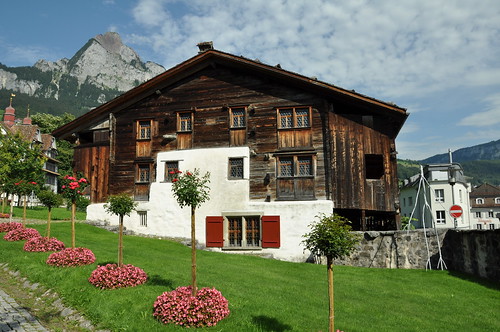
A wooden house known as Bethlehem House (Bethlehem-Haus)
in the small village of Schwyz, Switzerland. It is also claimed to be
Oldest Wooden House in Europe.
Eldhus in Zornsamlingarna Museum, Mora, Sweden
Eldhus (literally "fire house") are a type one-room timbered houses in
Sweden which consisted of a long room with a fireplace in the centre.
This particular Eldhus, which is now located in The Zorn
Collections, or Zornsamlingarna Museum in Mora, Sweden. As per tree-ring dating
(dendrochronology), the timber used to build the house dates from the year 1237.
It is claimed to be oldest in Sweden/Europe.
Bethlehem House (Bethlehem-Haus), Schwyz, Switzerland
Bethlehem House (Bethlehem-Haus), in Schwyz in central Switzerland was built in
1287 and was last occupied till the 1980s. It is a museum now and is claimed to be
oldest surviving wooden house in Switzerland/Europe.
Image from Flickr is by Stefan Schuler
Special
Note: This post is based on the information currently available on the Web. Due to
inherent insulating properties the wooden houses are more comfortable than stone
in cold regions and it is possible that there may be other older wooden houses in
temperate regions closer to Arctic or in higher regions like Tibet, Ladakh etc.
I will be happy if some one can find houses older than these houses.
Note: These houses are not to be confused with Oldest Wooden Structure, which is a
five-story Pagoda in
Hōryū-ji Buddhist Temple Complex in Ikaruga, Nara Prefecture,
Japan dating back to early seventh century. This post is about liveable
homes/houses.
"Built in 1746 by Nathan Wilbur, a sailor who had spent time in
Holland, the "Old Mill" is the oldest functioning mill in the country.
It is the only surviving mill of the four "smock mills" that once stood
overlooking Nantucket town. There was a fifth Nantucket mill called "Round-Top
Mill" on the site of the present New North Cemetery.
Smock mills have a fixed body containing machinery and a cap that turns to
face the sails into the wind. The Old Mill was sold for twenty dollars in 1828
to Jared Gardner in deplorable condition for use as "firewood."
Instead of dismantling it, Gardner, a carpenter by trade, restored the mill
to working condition capable of grinding corn.
The mill was sold once again in 1866 to John Francis Sylvia,
a Portuguese miller of Azorean descent, who operated it for many years with his
assistant Peter Hoy until it fell into disuse in 1892. In 1897 Miss Caroline
French purchased the mill at an auction for $850 and donated it to the Nantucket
Historical Association."
Update June 29, 2014: Subsequent to making this post I found that this house is not only the Oldest Wooden House in Europe, it is also the "The Oldest Still Inhabited Wooden House in the World". I have therefore made a fresh post about it by using text/images from this post and have also added more information/images in the new post. Please therefore view the Latest Post and ignore this post. Thanks.
While researching for my earlier post about the "Amazing
Turf Houses of Iceland", I came across an old turf-roofed house in the small
village of Kirkjubøur on the the island of Streymoy in Faroe Islands. As per several sources, it is one
of the oldest still inhabited wooden houses of the world and reportedly the
oldest inhabited wooden house in all of Europe. (Please see the note at the
end of this post)
The house dates back to 11th century and was originally the
residence of the bishop of the Diocese of the Faroe Islands. As per local legend
the house was initially constructed in Norway, then disassembled, its logs
numbered and then floated to the Kirkjubøur where these were reassembled.
The house and the big farm around it are called
Kirkjubøargarður (King's Farm) and are now owned by Faroese government. Its main portion, called Roykstovan,
houses a museum, however a part of the house is still occupied by a
local family whose past several generations are the traditional tenant since
16th century.
It is interesting to note that although this house and
several other houses on the Island have turf roof yet these are a bit
different from the turf houses of Iceland. The walls of these houses are made of
wood, unlike the houses in Iceland where the walls are also covered with layers
of earth and then turfed.
Note: Several websites especially those of Swiss
origin claim that a wooden house known as Bethlehem House (Bethlehem-Haus)
in the small village of Schwyz Switzerland is the oldest in Europe. As per
swissinfo.ch and other related websites the Bethlehem House was built in
1287, while the Kirkjubøargarður in the Kirkjubøur dates back to 11th
century. The claim that the house in Switzerland is the oldest in Europe,
therefore doesn't appear to be correct.
It may also be worthwhile to note that the World's Oldest Wooden Building is a five-story pagoda in Ikaruga, Nara Prefecture, Japan, which dates back to early seventh century.
The Olympic symbol of five interlocking coloured (blue,
yellow, black, green, and red) rings was adopted at the Olympic congress of
1912. Due to First World War, the Olympic games were not held in 1916 and the
Olympic rings were displayed for the first time ever, on a flag, during the 1920
Olympiad in Antwerp, Belgium and then again, on a flag, at the 1924 Olympiad at
Paris, France.
The first ever Olympic rings, in physical form, were
displayed on the entrance to the 1928 Olympic Stadium at Amsterdam and also on
its Flame tower. These rings are therefore the oldest Olympic rings in
existence.
Incidentally the modern day Olympic flame was lit for the first time
during the 1928 Amsterdam Olympics on a specially built Flame Tower known as the
Marathon tower.
Both the Stadium and the Tower are now listed as National
Monument of The Netherlands.
The Bourn Windmill, located in the town of Bourn, Cambridgeshire, is reportedly England's oldest surviving Windmill of its type. The earliest mention of about it is in the official records of its change of ownership in 1636, but it may have been constructed much earlier as this type of 'open trestle' post mills were in use from as early as 13th century.
The windmill is 9.6 metres (31.5 feet) high and its two floored body containing the machinery is about 3.2 metres (10.5 feet) by 4.42 metres (14.5 feet).
The mill was functional till 1925 when it was damaged by a gale. It has since been repaired/renovated but is not in use. The mill however is winded on the open days (usually last Sunday of each month) when canvas sails are clothed over the wings.
I am reproducing comments received today from Anonymous;
"I would research a little more before advertising the mill as "the oldest". The oldest DOCUMENTED windmill is in Pitstone, Buckinghamshire (1627)."
In reply I would like to add I always do research before making a post and I am well aware that Pitstone, Buckinghamshire is the oldest recorded windmill. However there are many references
on the web as well in the books which claim that Bourne Windmill is THE OLDEST. A few such references are being reproduced below; I leave it to my readers and historians to decide as to which Windmill is oldest!
"The small post mill at Bourn, which stands almost on the
parish boundary with Caxton, is generally regarded as the oldest surviving
windmill in the country, although the mill at Pitstone, Buckinghamshire, is the
earliest dated mill. The earliest reference to the mill at Bourn is 1636 ....."
"It is the oldest dated mill in the country, probably
considerably older than the earliest title-deeds of 1636 ......"
Mansfield Forbes and His Cambridge by Hugh Carey (Google
books)
"Although this tiny windmill cannot be dated exactly, it
is considered to be the oldest surviving open trestle post mill in Britain. A
deed of 1653 mentions it changing hands in 1636......"
"Bourn Windmill, which in 1931 was given to the
Cambridgeshire Preservation Society, is the oldest surviving open trestle mill
and is known to have been sold by deed in 1636 to Thomas Cook of Longstowe."
As per archaeologists the ruins found at a hilltop in south-eastern Turkey, known as Göbekli Tepe, are of the oldest temple structure discovered so far. Göbekli Tepe contains several nearly circular structures which have huge T-shaped pillars, some of which are carved. These megaliths date back to 10th millennium BC (c. 13,000 years ago) which is about 6000 years before Stonehenge and more than 10,000 years before the earliest Egyptian Pyramids.
The structures are remarkable in the sense that these massive carved pillars, which have a height of 3-6 metres and weigh 40-60 tonnes, were crafted and were erected when Man was still a nomad, concept of community living was unknown, organised farming had not started and there were no metal tools.
As per the official web page gobeklitepe.info the remarkable structures leave us "... scratching our heads as to how on earth they accomplished such a monumental feat. In a time when even simple hand tools were hard to come by, how did they get these stone blocks there, and how did they erect them? With no settlement or society to speak of, with farming still a far cry away, in a world of only roaming hunter-gatherers, the complexity and developed blueprints of these temples represented another enigma for archeologists...."
The site was first excavated in 1995 by Prof. Klaus Schmidt, a German archaeologist, and he believes that these are ruins of earliest known temple in the World. It is however not known as to who were the deities. However the stone carvings contains images of animals - Lion, Foxes, Snakes, Wild Boars, Water Birds and Scorpion etc. Some of the stones depicts multiple scenes as if trying to tell a story.
Screen captured images from Google Earth / Google Maps and Street Views / MSN Bing Aerial Views / Yandex Maps etc. are under the copyright of their respective owners. Similarly all other photos/images from various other sources are under the copyright of their respective owners, web portals/application etc from which these were obtained. Wherever possible due acknowledgement has been made about the source. Actual terms of copyright/reuse is available in the source link given below each image.
I solicit comments on my posts and also request information/ links to unusual places for inclusion in this travelogue. I will duly acknowledge my source of information.
If you are having any problem in opening Google Earth link then please let me know through comment box or e-mail me. I will send the desired kmz/kml file.
E-mail:
jaymasood-at-yahoo-dot-com
Smart Phone/Tablet Users
Read mobile version of this blog by scanning the QR code.