


Amazing See Through Church Of Borgloon
A highly interesting and visually impacting art work in the
shape of a church, with traditional spire, has been installed in an open area of
rural Borgloon, Limburg, Belgium. The walls, roof and the spire of so called
church are made of layers of steel flats with gap between each layer, somewhat
akin to a fully opened Venetian blind. This unusual design plays a visual trick
upon the viewer - depending on the angle of view and the elevation/location of
the viewer, the church either merges fully or partially with the landscape or
becomes totally visible to the beholder. Although officially called "Reading
between the Lines", it is quite often referred as "The See Through Church"
and also "The Invisible Church".
As per English translation of a part of text on the placard
installed near the art work;
"Thanks to
this special construction, the landscape is always visible through the church,
at a distance and close up. This means the church is always present, but also
absent in the landscape."
A quote from the
official page;
"Reading
between the Lines can be read as a reflection on architectural themes such as
scale, the ground plan etc., but the project also emphatically transcends the
strictly architectural. After all, the church does not have a well-defined
function and focuses on visual experience in itself (one could even consider it
to be a line drawing in space). At the same time, the construction demonstrates
that this experience is in effect a consequence of the design, since it
explicitly refers to the various stages in its conception: the design drawing,
the model… Apart from that, because the church does not fulfil its classical
function, it can be read as a heritage related reflection on the present vacancy
of churches in the area (and their potential artistic reuse)."
The 10 metres tall artwork which was commissioned on September 24th, 2011
was designed by Gijs Van Vaerenbergh, a partnership of two young artists
Pieterjan Gijs and Arnout van Vaerenbergh. It is part of the exhibition
project Z-OUT, an initiative of Z33, the Contemporary Art Museum of the city of Hasselt,
Belgium.
The Invisible Church is modelled after the village church
seen in the background.

Image from Picasaweb is by Noisette N
The village church as seen through the "See Through Church"
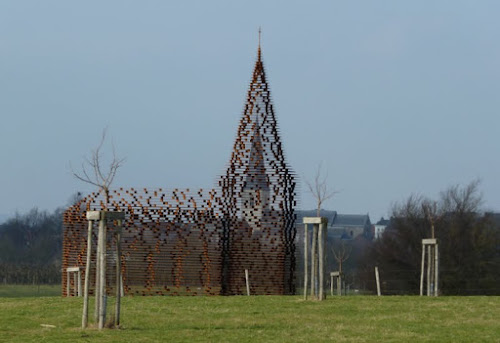
Image from Picasaweb is by Noisette N

Image from Flickr is by Z33 art centre, Hasselt

Image from Flickr is by Z33 art centre, Hasselt
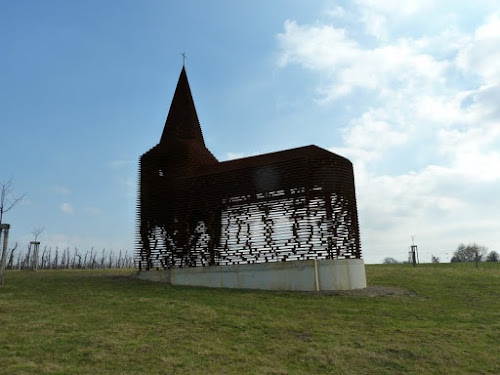
Image from Picasaweb is by Noisette N

Image from Picasaweb is by Noisette N

Image from Picasaweb is by Noisette N

Image from Flickr is by Z33 art centre, Hasselt
Time lapse Video of construction
View location in
Google Earth / Google Map (Because of
its recent construction it is presently not visible in Google Earth or Google
Maps. The location is based on the info given in the
Official webpage.)
Main source of info: Official
webpage of artists, Gijs Van Vaerenbergh /
architecturelab.net
Credits: Noisette, a Google Earth addict, volunteer moderator
of the Google Earth Community and top contributor in the Google Earth help
forum, was kind enough to visit the place to obtain its pictures for this blog.
Her images, especially the images of the invisible church with the local church
have raised this post to a higher level.
Thank you Noisette for taking all the trouble of visiting the place and taking
such beautiful pictures.
I am also thankful to Z33 art centre, Hasselt for placing their entire
collection under "Creative Commons". Being arm chair traveller I depend mainly
on CC images and their collection came in very handy for making this post.


0 comments:
Post a Comment