This blog is about the lesser known but beautiful, wonderful, huge, unique and sometimes bizarre places around the World. Started on January 1, 2009, it is an outcome of my association with Google Earth Community, which I joined in July 2006. Since then I have been regularly flying to almost all the corners of WWW (Whole Wide World) and have virtually adopted the age old motto - Perfect time to see the World is after retirement.
Google Earth Community Forum is full of information which ranges from, but not limited to; history, geography, nature, environment, architecture, military, transportation, beliefs, festivals, huge, unique, bizarre items, current happenings etc etc.
My favourite section in the Community is "Fun and Games" - in which members post riddles and puzzles on almost all subjects and generally give hints for searching and locating the relevant places and or events on Google Earth. I have made several hundred posts in this forum and must have solved about the same number, though several were beyond my grasp. Believe me it is not easy to solve these riddles - Finding the answer is 90% perspiration (research) and 10% inspiration but it is pure 100% joy and sense of exhilaration.
This forum provides a stimulus to my brain and keeps it active. I strongly recommend this for those who have time and penchant for solving puzzles, but a word of warning – it is highly addictive.
My travels around the World are not limited to Fun and Games only, however many of the places being covered in this travelogue were found as a result of my researches for making posts in Fun and Games or trying to solve the riddles given therein.
The Original Google Earth Community was frozen by Google in April 2015 and finally killed in April 2019. However the dedicated moderators of the defunct Original GEC created a new Board for the GEC enthusiasts and the new Community is known as "Google Earth Community Forums". This new community continues to function as the old GEC but is independent of google.com
Google Earth
To view the Google Earth links given in this travelogue, the "Google Earth" application should be installed in your system. If it is not, then click on following button to get it!
All other links can be directly accessed through your browser.
A climbing wall is an artificially constructed wall with grips for hands and feet, used for climbing. Most of the climbing surfaces are created on the walls of some existing building or even a dam's face. Most modern walls have a thick multiplex board with holes drilled into it. Each hole contains a specially fitted nut to allow modular climbing holds to be screwed on to the wall. (Source: Wikipedia).
The town of Groningen, The Netherlands boasts of highest free standing climbing wall (actually a tower) in the World. Located at Klimcentrum Bjoeks (Bjoeks Climbing Centre) the curved climbing tower is 37 metres tall and is known as the Excalibur.
Besides the Excalibur the Bjoeks climbing centre has a indoor climbing hall and several free-standing boulders dotted around it.
Main source of info and more info : UKClimbing.com. (Good description and video.)
Credits: Kite_surfer for his great post in Google Earth Community entitled "the dutch mountains (2)" which brought this place to my knowledge. Thank you Kite.
World's largest foosball table was built in open air in Berlin, Germany with a playfield having a whopping size of 11 metres x 6 metres (~36.09 x 19.69 feet).
It was installed around December 2005 for the 2006 FIFA World Cup held at Berlin. Present status whether it still exists or has been dismantled is not known. (Update: In all likelihood it has been dismantled. It can be seen in Google Earth images of 12/2005 and 05/2006 but cannot be seen images of subsequent years.)
Foosball also known as Table football or Fussball is a table-top indoor game/sport based on the sport of soccer/football. Invented in 1922-23 it is very popular in many countries around the World and it is generally played for fun in several pubs, bars, workplaces, schools, and clubs.
With rise in its popularity it is now being played at professional level also and has its own governing body called International Table Soccer Federation (ITSF) established in 2002 with the mission of promoting the sport, framing standard rules and regulating international competitions.
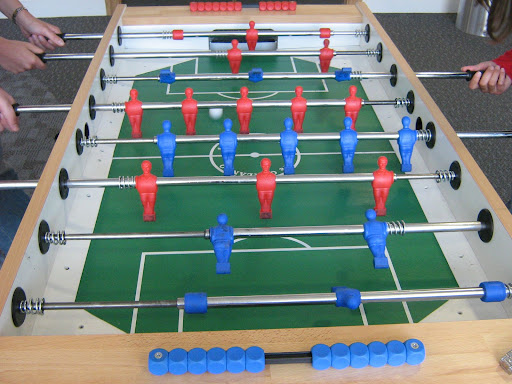
The football players are actually figures (called foosmen) mounted on rods and the foosball players control their team by means of sliding and/or turning the rods to kick the ball in opponent's goal.
The game played by two teams can have 2-13 foosmen each depending on the size of the table. Most common is 4 player (2 persons per team) table with 4 rods and 11 foosmen for each team. Typical formation of foosmen, which may differ from table to table, is;
Goal keeper rod - 1,
Defensive rod - 2 foosmen,
Midfield rod - 5 foosmen and
Offensive rod - 3 foosmen.
The size of the table also varies from place to place. An average table has a dimension of 148 x 76.5 cm (58.3 x 30.1 inch) with a playfield size of 114.5 x 69.5 cm (45.1 x 27.4 inch).
Here is a typical foosball game in progress;
Image from Picasaweb is by Alvar
Credits: I am thankful to Seer, Member and 'Master Chronicler' of Google Earth Community (GEC) Forum whose above referred post (Giant Fussball Table) brought this to my knowledge. Seer is one of the earliest (probably founder) members of GEC and has made several hundred fantastic posts about various places around the World. The quality of his posts can be gauged by the fact that he has an exclusive section in the forum entitled "The Seer's Best".
World's largest baseball bat can be found near the Louisville Slugger Museum cum Factory, Louisville, KY, USA. The 120 feet (~36.57 metres) tall bat, made of hollow carbon steel, weighs 68,000 pounds (~ 30.8 Tonnes) and appears to leans against the museum wall. However it is free standing and none of its load is transferred to the wall. Reportedly the bat is modeled after Babe Ruth's bat.
The Louisville Slugger Museum is not only a a museum but is also their factory. Baseball bats have been manufactured here since 1884 and "Louisville Slugger" bats are the official standard bats of Major League Baseball.
The bat is an enormous attention-getter and very popular tourist spot. To take full advantage of the fame of the bat, Kentucky Mirror & Plate Glass Co., who are next door to the Louisville Slugger Museum, have put up their advertising mural (shown below) on a wall facing the museum and it depicts a shattered glass window complete with a ball which is comparable in size to the enormous bat at the Museum. The painted ball resemble a baseball down to the stitches. (The mural can also be seen behind the tree in the 2nd and 3rd images above.)
Zorbing is an extreme sport in which a person or 2/3 persons rolls down a slope in a big double air-walled transparent spherical ball. Though generally performed on a slope it can be done on level surface or water also.
The runs are about 500-800 metres and the sport was first introduced in Rotura, New Zealand. It is however now in vogue in many countries.
The ball is a double-sectioned sphere, with one ball inside the other with an air layer between. This acts as a shock absorber for the rider, dampening bumps while rolling. Many balls have straps to hold the rider in place, while others leave the rider free to walk the sphere around or be tossed about freely by the rolling motion - water can be added inside, and this is commonly called a "water ride". A typical ball is about 3 metres in diameter, with an inner sphere size of about 2 metres leaving a 50–60 centimetre (20–24 in) air cushion around the riders. The inner and outer sphere are connected by hundred of connectors and filled with air.
Caution: There have been couple of incidence of injury and even death of riders. So before embarking in this sport one must take into account all necessary safety precautions and check the safety features available at the Zorbing site.
Screen captured images from Google Earth / Google Maps and Street Views / MSN Bing Aerial Views / Yandex Maps etc. are under the copyright of their respective owners. Similarly all other photos/images from various other sources are under the copyright of their respective owners, web portals/application etc from which these were obtained. Wherever possible due acknowledgement has been made about the source. Actual terms of copyright/reuse is available in the source link given below each image.
I solicit comments on my posts and also request information/ links to unusual places for inclusion in this travelogue. I will duly acknowledge my source of information.
If you are having any problem in opening Google Earth link then please let me know through comment box or e-mail me. I will send the desired kmz/kml file.
E-mail:
jaymasood-at-yahoo-dot-com
Smart Phone/Tablet Users
Read mobile version of this blog by scanning the QR code.